 United Kindom
 United States
 Europe
 Australia
 France
 Spain
Spain
 Italy
Italy
 Canada
9 Best Wooden Baby Walkers with Busy Boards for Active Play
Sep 15,2026 | Robud-UK
Somewhere between the first wobbly stand at the coffee table and those triumphant, unsupported steps across the living room, babies hit a stage where they want to be upright, moving, and occupied, all at the same time. A wooden push walker with a busy board built into the front is one of the few toys that actually keeps pace with that stage: it offers steady support while they walk, and it gives their hands something to explore the second they stop.
Robud makes a full range of these walkers, and picking between nine good-looking wooden options can get overwhelming fast. Below, we've broken down our full collection, what each one does best, and how to think about choosing between them.
In this article:
What Is a Wooden Baby Walker with a Busy Board?
A wooden baby walker with a busy board is a push-along toy built specifically for babies who are learning to stand and take their first independent steps. It has a wide, weighted wooden base, a handle at a height small hands can grip, and wheels (usually rubber-trimmed) that roll at a controlled pace so the baby isn't yanked off balance the moment they push.
The "busy board" part is the front or side panel packed with small interactive elements: spinning gears, bead mazes, xylophone keys, mirrors, shape sorters, clocks, or flip tiles. These give babies a reason to pause, crouch, and fiddle before standing back up and walking again, which is exactly the kind of stop-start movement that can encourage practice with coordination, balance, and confidence over time.
Because the whole thing is made from wood rather than moulded plastic, it also tends to look like a piece of furniture rather than a toy that's been left out. That matters more than it sounds like it should when the walker lives in your lounge for the better part of a year.
Our Top 9 Wooden Baby Walkers with Busy Boards
ROBUD Forest Fairy Baby Push Walker — Best Overall
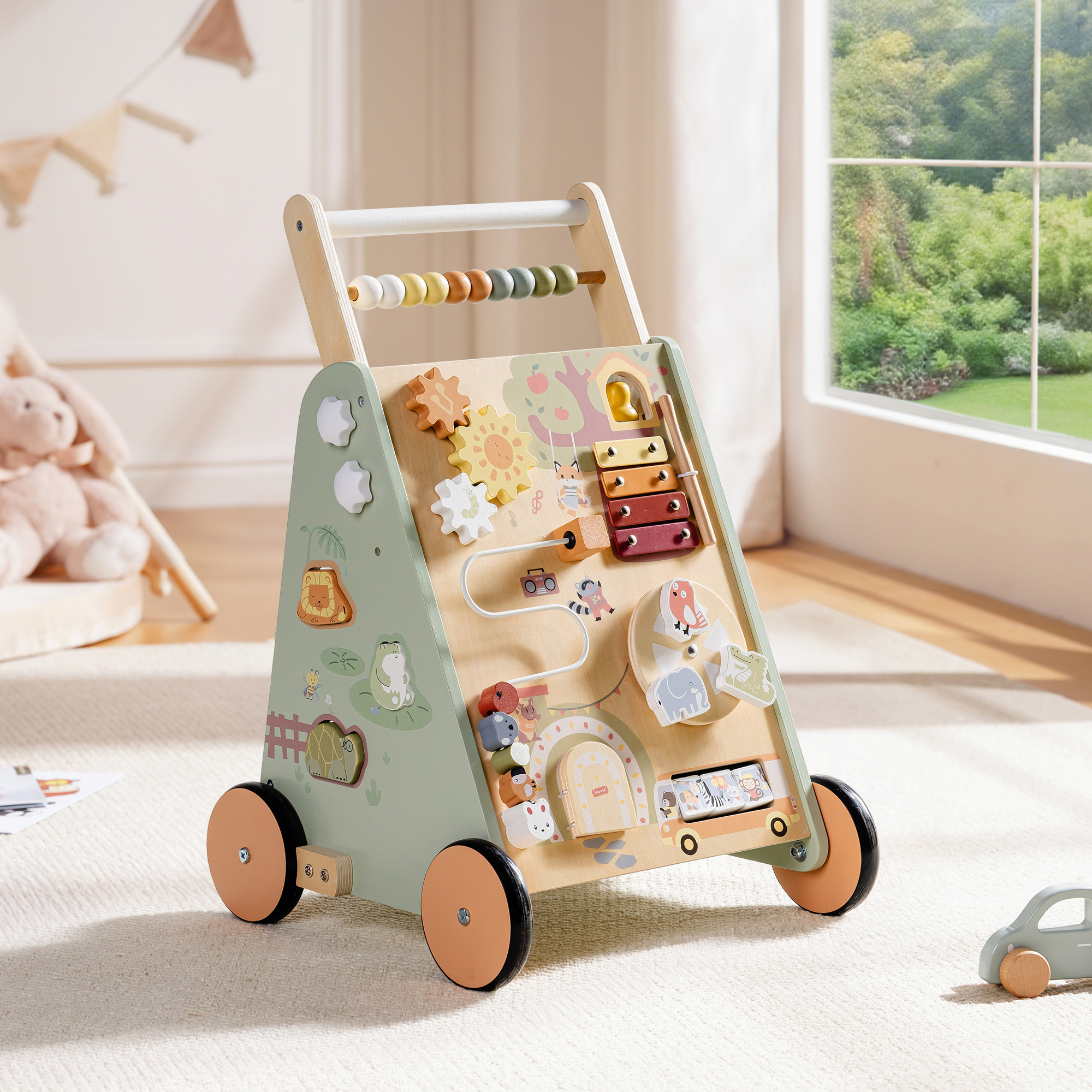
- Adjustable height and speed: the walker's settings can be changed as your baby grows and gets steadier on their feet.
- Six-plus busy board activities: abacus, gears, xylophone keys, a bell, an animal bead maze, a spinning ferris wheel, and a shape sorter.
- Built-in storage compartment: a rear pocket for carrying a favourite plush toy or blocks.
- Brake function: helps keep strolling controlled at every stage.
This is the walker we'd point most parents toward first. It has the widest spread of busy board activities of anything in the range, plus the adjustable height and resistance to keep working as your baby's walking skills improve. The forest fairytale theme is genuinely pretty too, which is a nice bonus for a toy that's going to sit in your living room for months.
ROBUD Forest Vitality Stroller — Best for Multi-Sensory Discovery
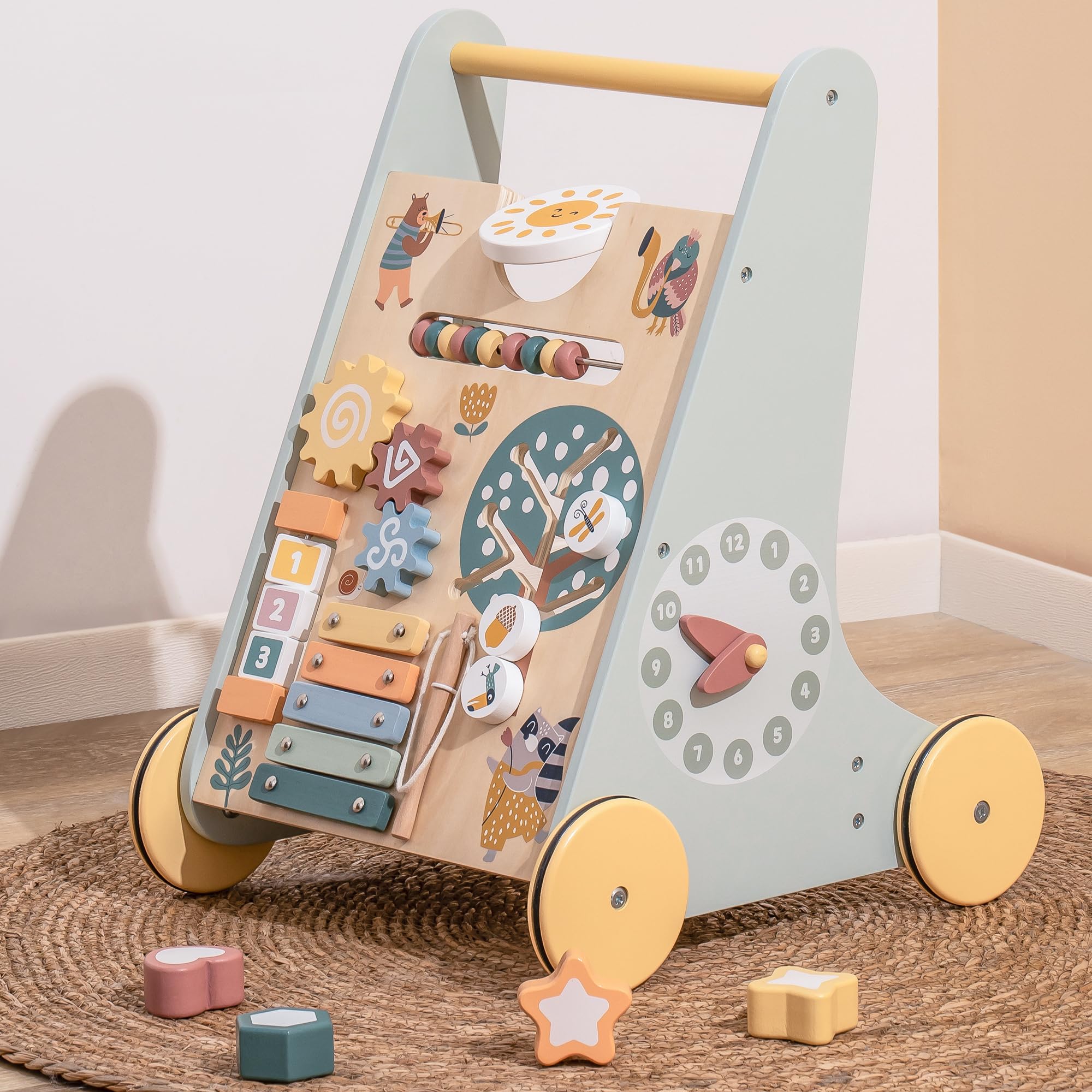
- Non-slip rubber wheel bands: designed to let babies brake gradually instead of rolling away too fast.
- Dense busy board: a small mirror, abacus, gears, xylophone, wisdom tree, shape puzzles, and a clock.
- Rounded, burr-free edges: every surface is smoothed for safety during unsupervised fiddling.
- Large wheelbase: built with tipping resistance in mind.
If your baby is the type who wants to touch, spin, and press absolutely everything, this is the one to grab. The sheer number of small activities packed onto the front panel means there's always something new to discover, which keeps active, curious babies engaged well past the "brand new toy" phase.
ROBUD Wooden Baby Push Walker Green Farm — Best for Montessori-Style Learning
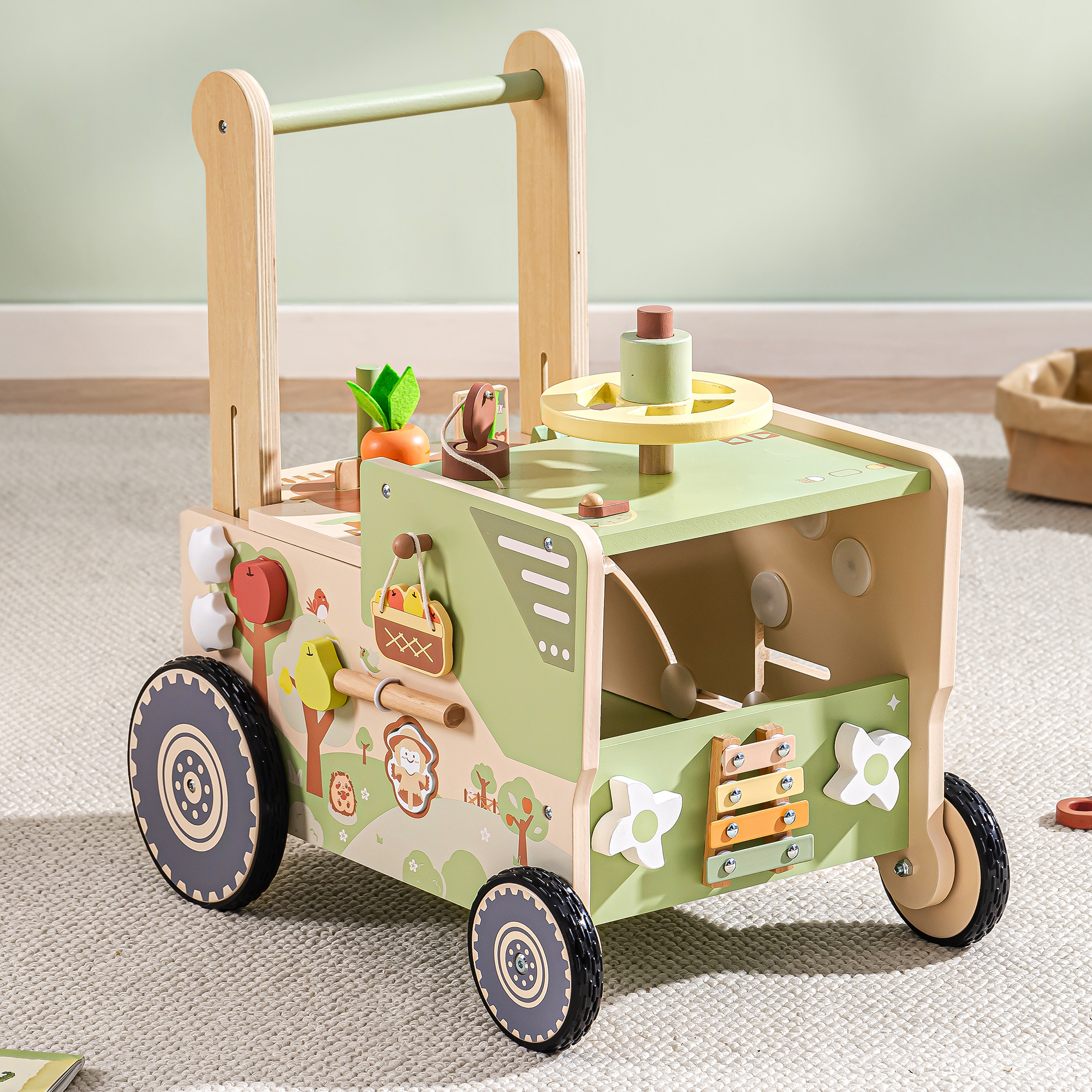
- Adjustable height and speed control: settings can be changed to suit your baby's current stage.
- Farm-themed play elements: spinning gears, animal sliders, and a simulated planting activity.
- Solid wooden build: smooth surfaces and rounded edges throughout.
- Montessori-inspired design: activities are built around real cause-and-effect actions rather than lights and noise.
This one leans into hands-on, process-based play rather than flashy sound effects, which fits nicely if you're building a Montessori-style play space at home. The farm orchard theme also gives you a natural excuse to talk about animals and planting while your baby walks and plays.
ROBUD Wooden Baby Push Walker Rattan — Best for Pretend Play
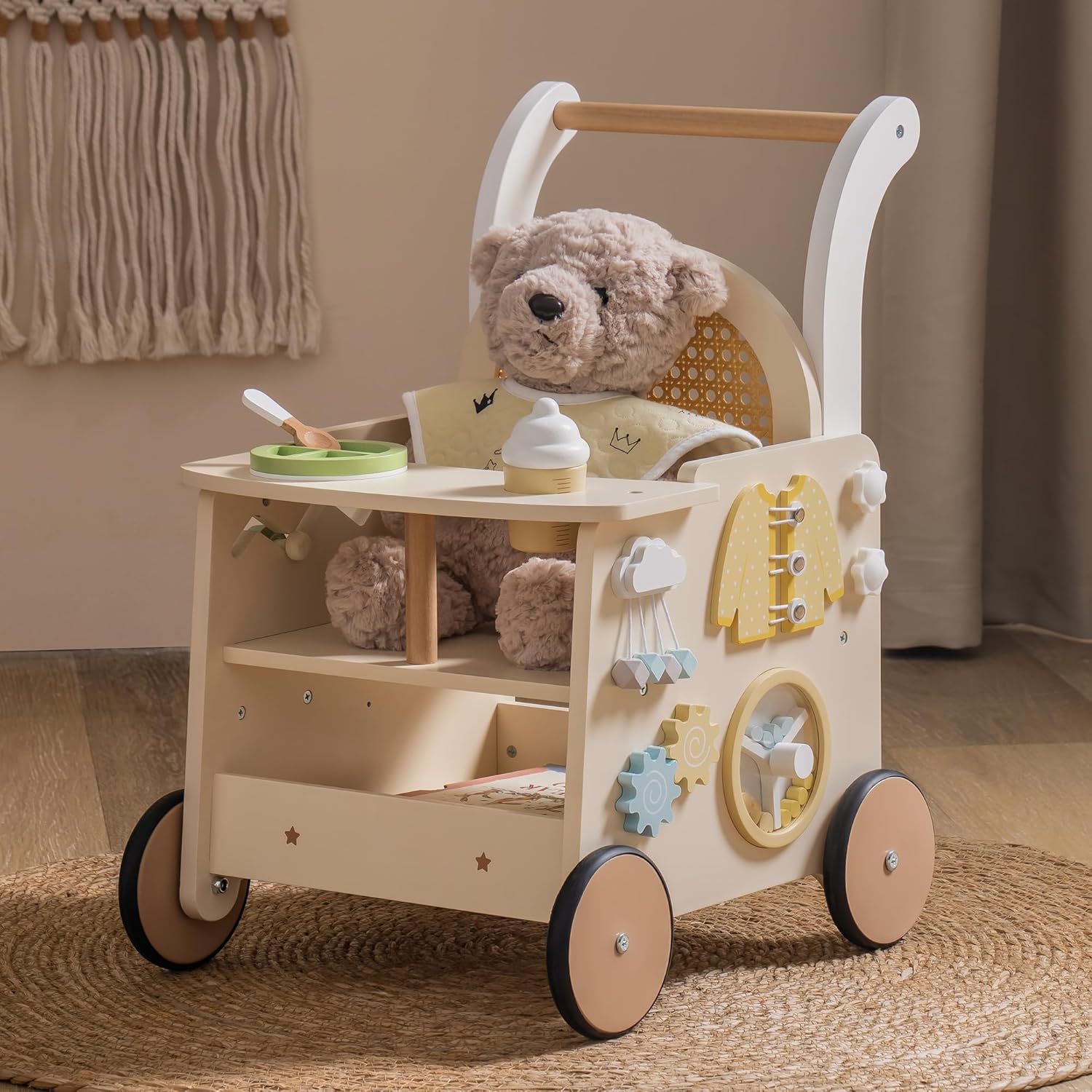
- Dual function: works as both a walker and a doll stroller, with dedicated storage space.
- Interactive activity panel: zippers, buttons, and a simulated washing machine with rolling beads on one side, a bottle and plate for pretending to feed on the other.
- Safety brake system: keeps the walker from slipping out from under a wobbly first step.
- Rounded wooden construction: a smooth, burr-free surface throughout.
Once your baby can walk a little more confidently, this walker doubles as a stroller for a favourite doll or teddy, which extends the toy's life well past the "learning to walk" stage. The zippers and buttons on the activity side also make it a strong pick for babies who love repetitive, hands-on fiddling.
ROBUD Wooden Baby Push Walker - Vacaction Bus — Best for Adventure-Themed Active Play
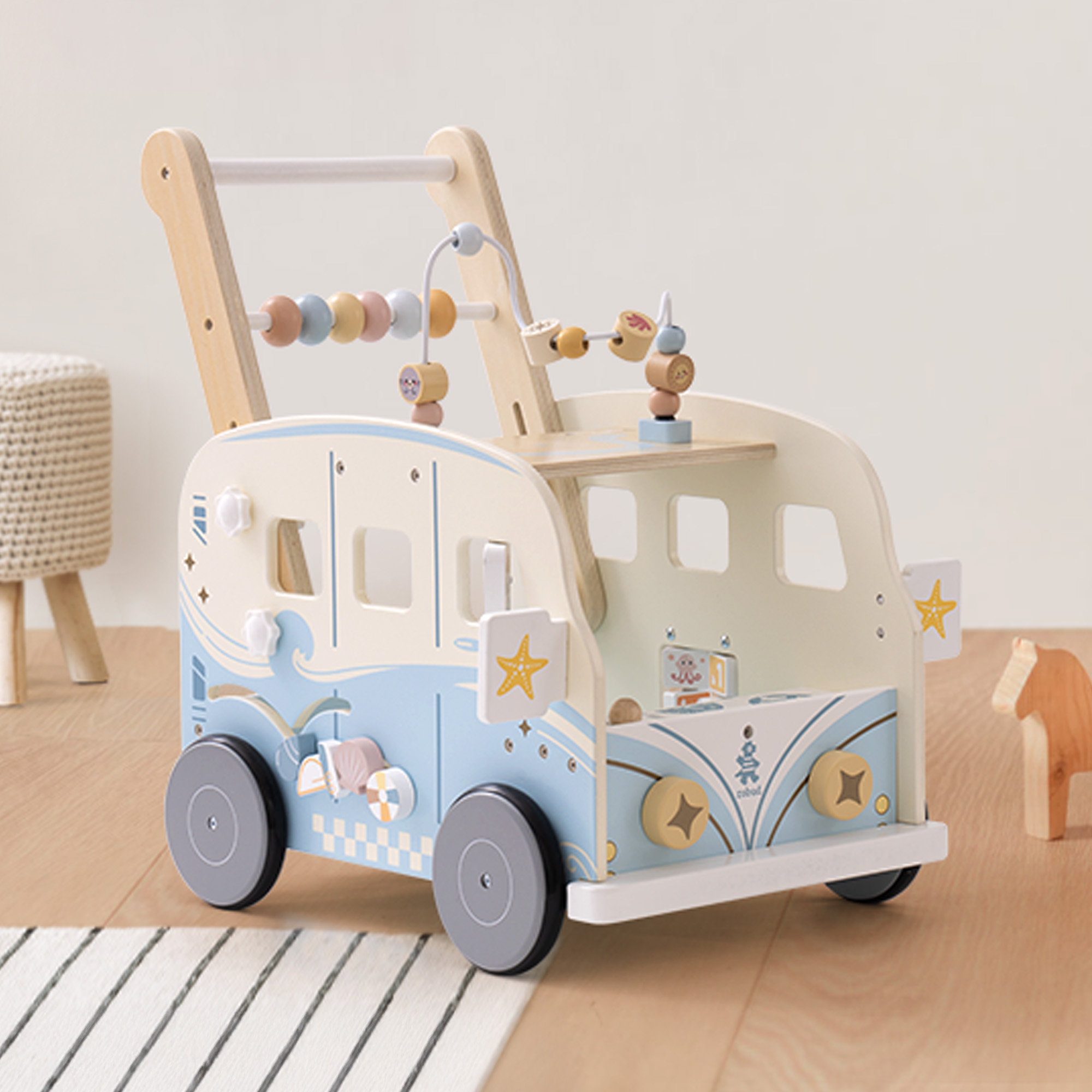
- Adjustable speed resistance: parents can change the rolling pace to suit their baby's current stage.
- Whale and lighthouse activity blocks: flip tiles that build fine motor skills through repeated play.
- Tracking maze and gear lever: a winding rail activity plus a lifelike lever for role-play.
- Car lights and sounds: press-activated features that reward active exploration.
Built around a holiday bus theme, this walker gives active babies plenty of physical actions to repeat: flipping blocks, tracing the maze, pressing the lever. It's a strong option if your baby responds well to toys with a bit of light-up, sound-based feedback.
ROBUD Wooden Pink Baby Walker — Best All-Rounder for First Walkers
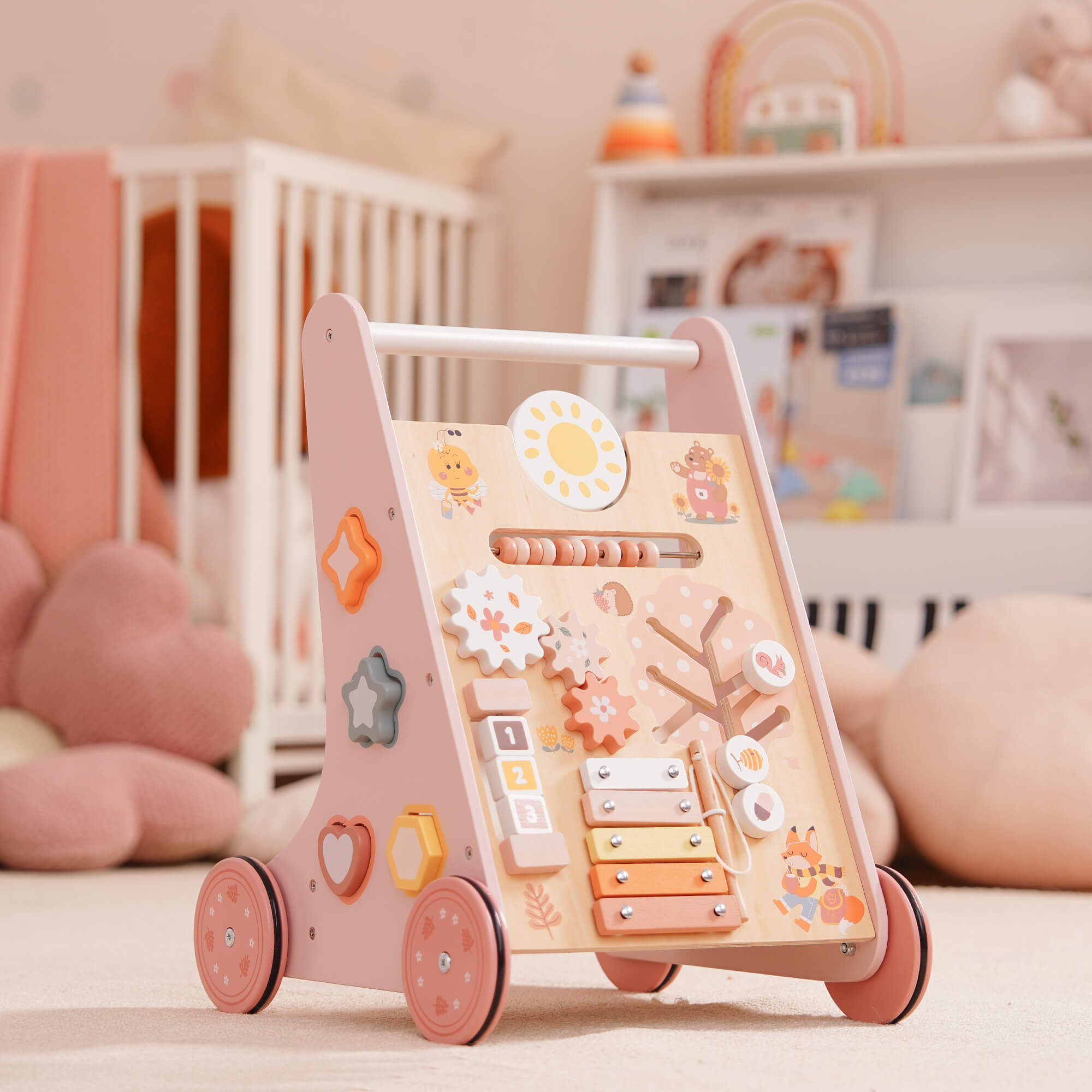
- Non-slip rubber wheels: designed to help protect floors and slow rolling.
- Full busy board: a mirror, beads, gears, xylophone, wisdom tree, shape puzzles, and a clock.
- Large, well-balanced wheelbase: designed with tipping resistance in mind.
- Soft, elegant colour palette: gift-ready packaging included.
This is a well-rounded, no-fuss walker that covers the essentials without overcomplicating things: sturdy wheels, a genuinely varied busy board, and a design that won't clash with a nursery colour scheme. A safe first pick if you're not sure which theme to go for.
ROBUD Wooden Baby Push Walker - Green Vacation Bus — Best for Boys Who Love Vehicles
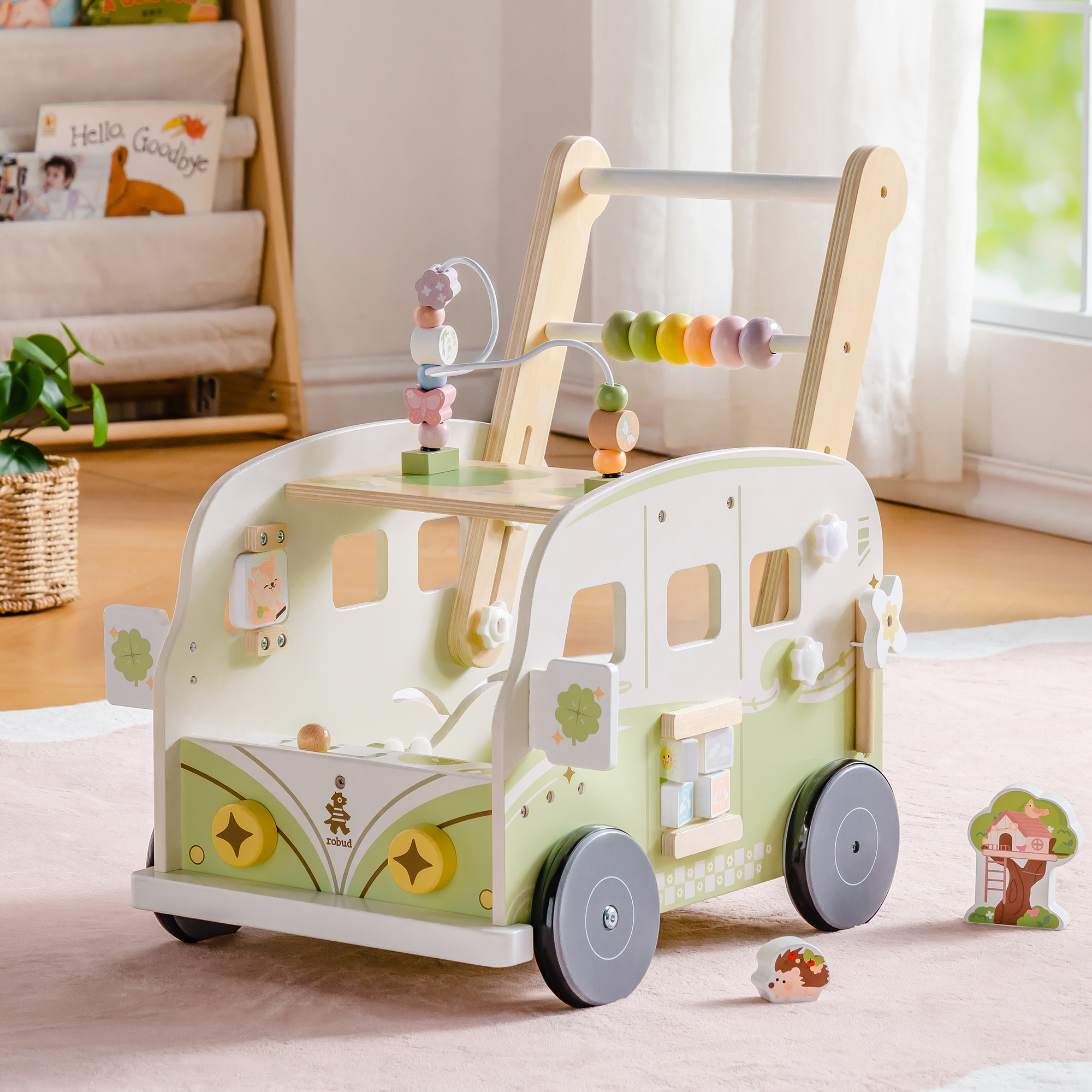
- Whale and lighthouse activity blocks: the same flip-tile play as the original Vacation Bus, in a green colourway.
- Rearview mirror and gear lever: small role-play touches that mimic driving.
- Tracking maze: a winding rail for repetitive hand-eye coordination practice.
- Interactive lights and sounds: activated through the car's play features.
If your household has already gone all-in on a vehicle theme for the nursery, this green take on the Vacation Bus walker slots straight in. Every activity that makes the original a good busy board pick is here, just dressed in a different colour.
ROBUD Wooden Baby Push Walker - Pink Vacation Bus — Best for Coordinated Nursery Décor
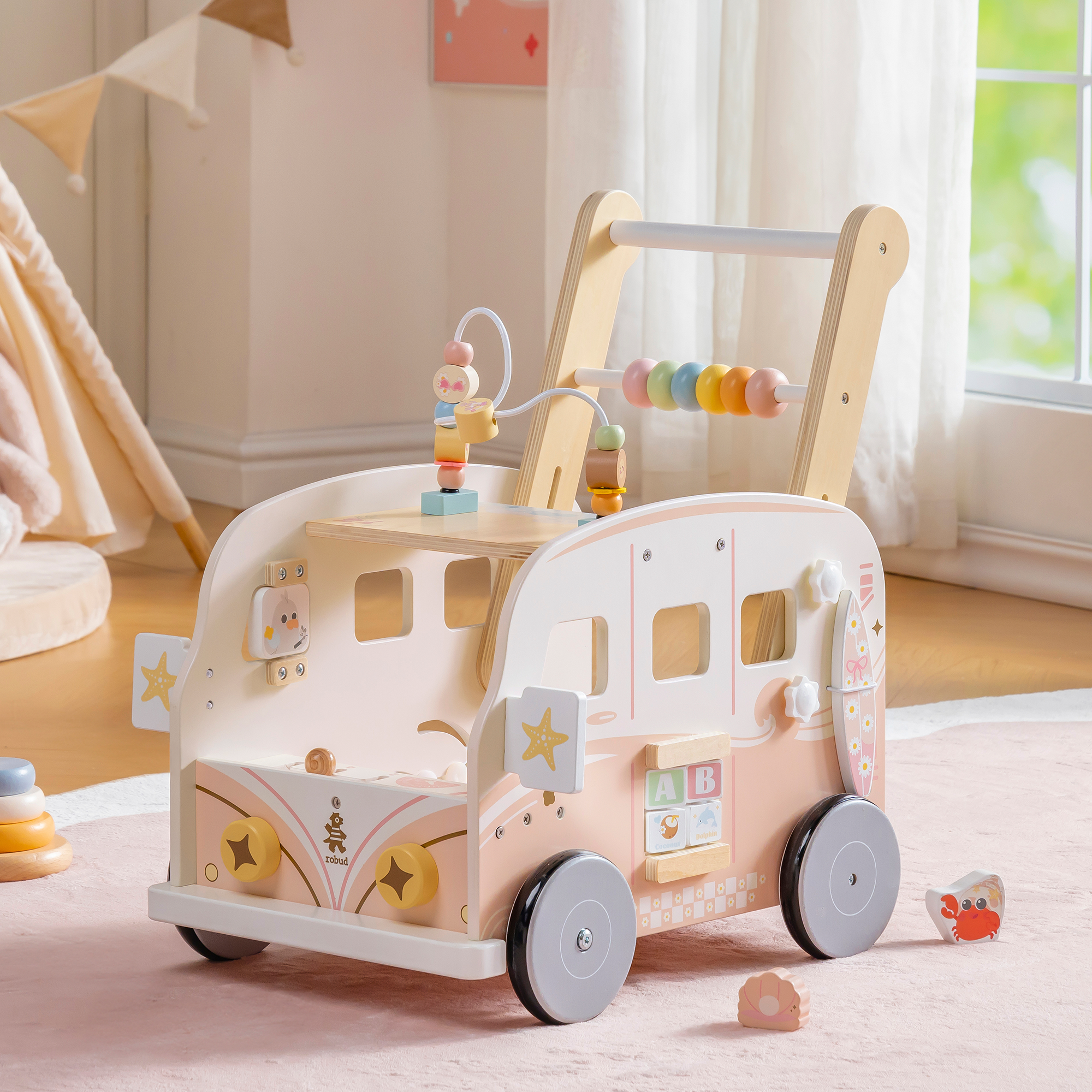
- Whale and lighthouse activity blocks: flip-tile play built for small, repetitive movements.
- Adorable rearview mirror and gear lever: sparks imaginative, role-play-style pushing.
- Tracking maze and car sounds: keeps active hands and ears engaged mid-walk.
- Adjustable resistance: rolls at a pace that matches your baby's confidence.
This is the pink version of the Vacation Bus, and it's an easy match if you're decorating around soft pastels. Functionally, it's identical to its green counterpart, so the choice really just comes down to which colour fits your space.
ROBUD Wooden Baby Walker with Garden Activity Center — Best for Growing With Your Child
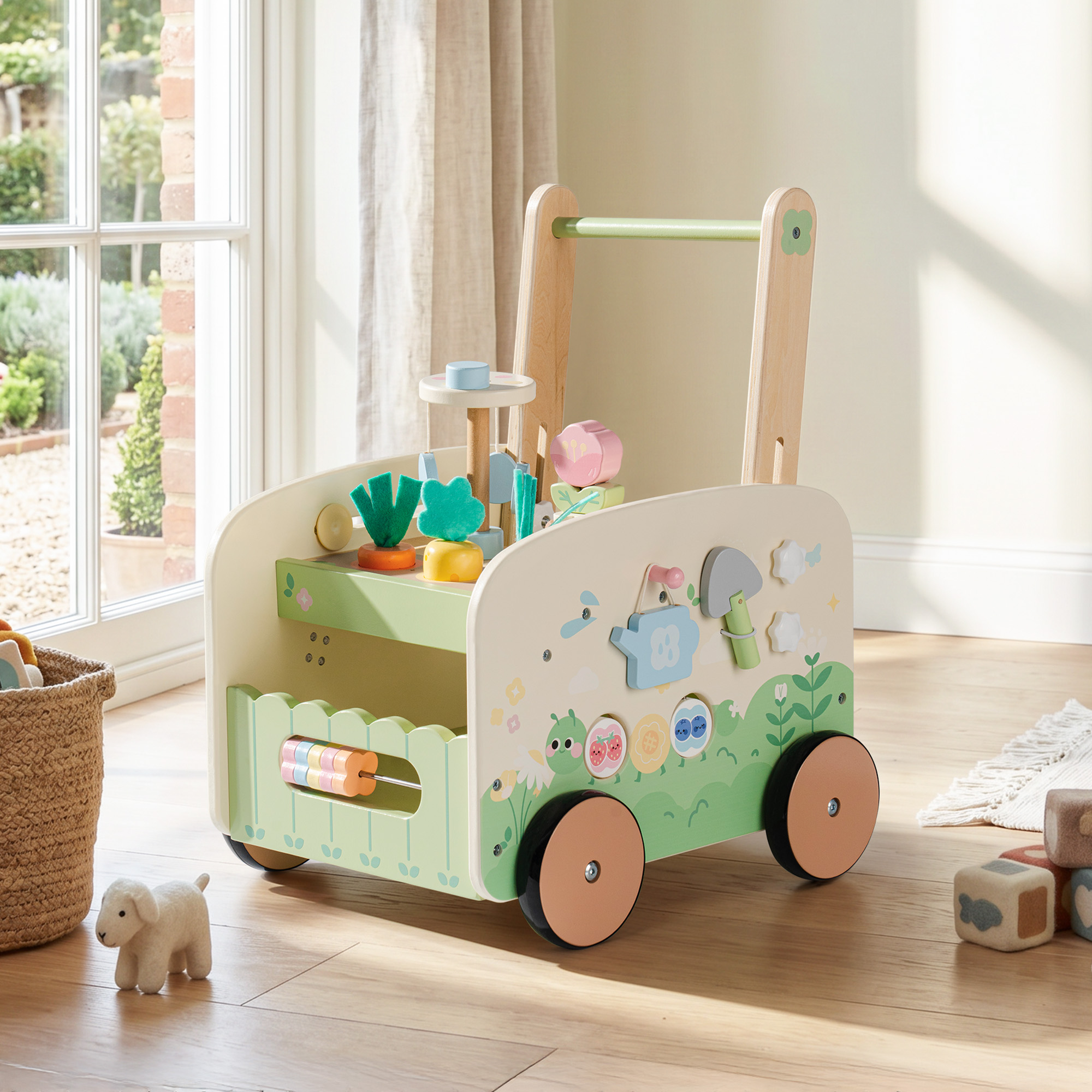
- Adjustable handle height: extends from 17 to 19 inches as your baby gets taller.
- Adjustable wheel resistance: anti-slip rubber wheels for a steadier, more controlled ride.
- Garden-themed busy board: a flower wheel, bee slider, butterfly clapper, veggie matching game, flower beads, and a drip-watering spinner.
- Rear storage compartment: room for stuffed animals or blocks, plus an early lesson in tidying up.
Because the handle itself adjusts in height, this walker has a genuinely longer usable window than most, which makes it worth a look if you'd rather not replace a walker every few months. The garden theme also gives you plenty of real-world vocabulary to build into playtime.
Are Wooden Push Walkers Good for Babies?
Generally speaking, wooden push walkers can be a useful part of a baby's early walking practice, provided they're introduced at the right stage. Once a baby can pull themselves up to stand and cruise along furniture, a push walker offers a stable, waist-height support to lean on while they practise the mechanics of walking: shifting weight, taking steps, and staying upright without holding a parent's hands the whole time.
The busy board element can add to that. Because babies naturally stop to investigate anything interesting, a walker with gears, beads, or a xylophone built in gives them a reason to pause, crouch down, and stand back up again, which can support that kind of repeated movement during early walking practice.
Stability and build quality come down to the specific design rather than the material alone, so it's worth checking a walker's base width, weight, and wheel setup rather than assuming any wooden model will automatically be steadier than a plastic one, or vice versa. As with any walker, supervision matters: keep it away from stairs, use it on a flat, obstacle-free floor, and stop using it once your baby is walking confidently without support.
Push Walker vs. Sit-In Baby Walker: What's the Difference?
The terms get mixed up a lot, but push walkers and sit-in baby walkers are genuinely different toys, and paediatric guidance treats them very differently too.
A sit-in baby walker has a fabric seat suspended inside a wheeled frame. The baby sits with their feet on the floor and propels themselves around by pushing off with their toes. These have been flagged by paediatric bodies including the American Academy of Pediatrics for years, mainly because of the risk of falls down stairs and because they can let babies reach objects (like hot drinks or cleaning products) they wouldn't normally get to. There's also some evidence that they don't help walking development and may briefly delay it, since babies get around without needing to practise standing balance in the same way.
A push walker, on the other hand, is a wheeled toy that a baby stands behind and pushes forward while walking on their own two feet. It offers support rather than carrying the baby, which means every step still involves the baby's own balance and effort. This is the category all of Robud's walkers fall into, and it's the type most commonly recommended once a baby is ready to start cruising and taking their first independent steps.
How to Choose the Right Walker for Your Baby
A few things are worth checking before you pick a walker, wooden or otherwise:
- Readiness stage: choose a baby walker with busy boards for a baby who can already pull themselves up to stand and cruise along furniture, usually somewhere around 9 to 12 months.
- Base stability: a wide, low wooden base with a decent amount of weight will resist tipping far better than a narrow or lightweight frame.
- Wheel resistance: adjustable resistance lets you slow the walker down for a newer walker and loosen it up as they get steadier.
- Handle height: fixed handles work fine for a shorter window, but an adjustable handle stretches the walker's useful life as your baby grows.
- Busy board fit: match the activities to what already holds your baby's attention, whether that's spinning gears, sound-making buttons, or simple flip tiles.
- Safety certification: look for CE marking and EN71 testing, which confirms the toy meets recognised safety standards for materials and construction.
- Floor surface: wooden walkers with rubber-trimmed wheels tend to grip better on hard flooring and protect it from scuffs at the same time.
- Storage and extras: a rear compartment for toys, or a walker that doubles as a stroller later on, adds a bit of extra mileage to the purchase.
FAQs
At what age can a baby start using a push walker?
Most babies are ready somewhere between 9 and 12 months, once they can pull themselves up to stand and cruise along furniture on their own.
Are wooden baby walkers safer than plastic ones?
Not automatically. Safety and stability depend on the specific design, such as base width, weight, and wheel setup, rather than the material alone. It's worth checking these details for any walker, wooden or otherwise, alongside supervision and a flat, clear floor space.
Do busy boards actually help with development?
Busy board elements are generally designed to encourage practice with fine motor skills, cause-and-effect thinking, and hand-eye coordination. The repeated pausing and standing they invite may also support general movement practice during early walking, though how much this shows up varies from baby to baby.
How do I clean a wooden baby walker?
A soft, slightly damp cloth is usually enough for wooden walkers finished with child-safe, non-toxic paint. Avoid soaking the wood or using harsh chemical cleaners, and let it air dry fully before your baby uses it again.
Can a push walker be used outdoors?
Most wooden push walkers are designed for smooth, flat indoor floors rather than outdoor terrain, since uneven ground can affect stability. For outdoor active play, a wheeled option built for that purpose, like a gardening trolley, is a better fit.
When should my baby stop using a push walker?
Once your baby is walking confidently without needing anything to hold onto, the walker has generally done its job. Many parents keep it around a little longer anyway, since the busy board features still get plenty of use.
Comment