 United Kindom
 United States
 Europe
 Australia
 France
 Spain
 Italy
 Canada
Mud Kitchen Ideas for EYFS: 15 Activities for Learning Through Play
Oct 13,2026 | Josephine Delima
Walk past any good nursery garden and you'll usually spot it before you spot the children: a battered wooden kitchen unit, caked in dried mud, with a queue of three-year-olds waiting their turn at the sink. That's a mud kitchen, and it's quietly become one of the hardest-working pieces of equipment in early years settings.
If you're a nursery manager, childminder, reception teacher, or a parent trying to bring a bit of that outdoor magic home, this guide covers everything you need: what a mud kitchen actually is in EYFS terms, why practitioners rate it so highly, which Robud mud kitchens are genuinely built for young children, and fifteen activity ideas you can start using tomorrow.
In this article:
- What Is a Mud Kitchen in EYFS?
- Why Are Mud Kitchens Good for EYFS Children?
- 15 Mud Kitchen Activity Ideas for EYFS
- Robud Mud Kitchens Built for EYFS Play
- The Activity Ideas
- What Do You Need for an EYFS Mud Kitchen?
- How to Set Up a Mud Kitchen for Nursery or Preschool
- Making Mud Kitchen Play Part of Outdoor Learning
- FAQs
What Is a Mud Kitchen in EYFS?
A mud kitchen is an outdoor play station, usually built from wood, that mimics a real kitchen with a sink, hob or stove top, worktop, and storage shelves. Instead of pots of food, children fill it with mud, water, sand, leaves, petals, and whatever else the garden offers that day.

In EYFS settings (the Early Years Foundation Stage, covering children from birth to age five), a mud kitchen isn't a novelty corner. It's a deliberate piece of provision that practitioners set up to support several areas of learning at once, from physical development to early maths. A mud kitchen isn’t only about mud; it doubles as a sensory station, a role-play stage, all built into one sturdy outdoor unit.
Why Are Mud Kitchens Good for EYFS Children?
Mud kitchens earn their keep because they support so many of the EYFS's seven areas of learning through play that never feels like a "lesson."
Here's how it breaks down in practice:
- Physical development: Scooping, pouring, stirring, and carrying jugs of water supports the strength of small hand muscles children need for writing later on, while lifting and reaching builds core strength and coordination.
- Communication and language: Mud kitchens are magnets for chatter. Children narrate what they're cooking, negotiate who's making the soup, and pick up new vocabulary like "mix," "drizzle," "measure," and "stodgy" almost without noticing.
- Personal, social and emotional development: Sharing one sink between four children gives support to social development.
- Mathematics: Filling containers, comparing "more" and "less" mud, and counting out ingredients for a recipe introduce volume, capacity, and number in a completely hands-on way.
- Expressive arts and design: Mud kitchens are open-ended by nature, so a "cake" one day becomes a "potion" the next. Thus, it offers support to kids to assist them in inventing, imagining, and retelling stories through play.
15 Mud Kitchen Activity Ideas for EYFS
Robud Mud Kitchens Built for EYFS Play
Robud, the outdoor play arm of Robotime, makes a small range of wooden mud kitchens designed with exactly this kind of durability and group use in mind. Here's an honest look at the current line-up and where each one fits best in an EYFS setting:
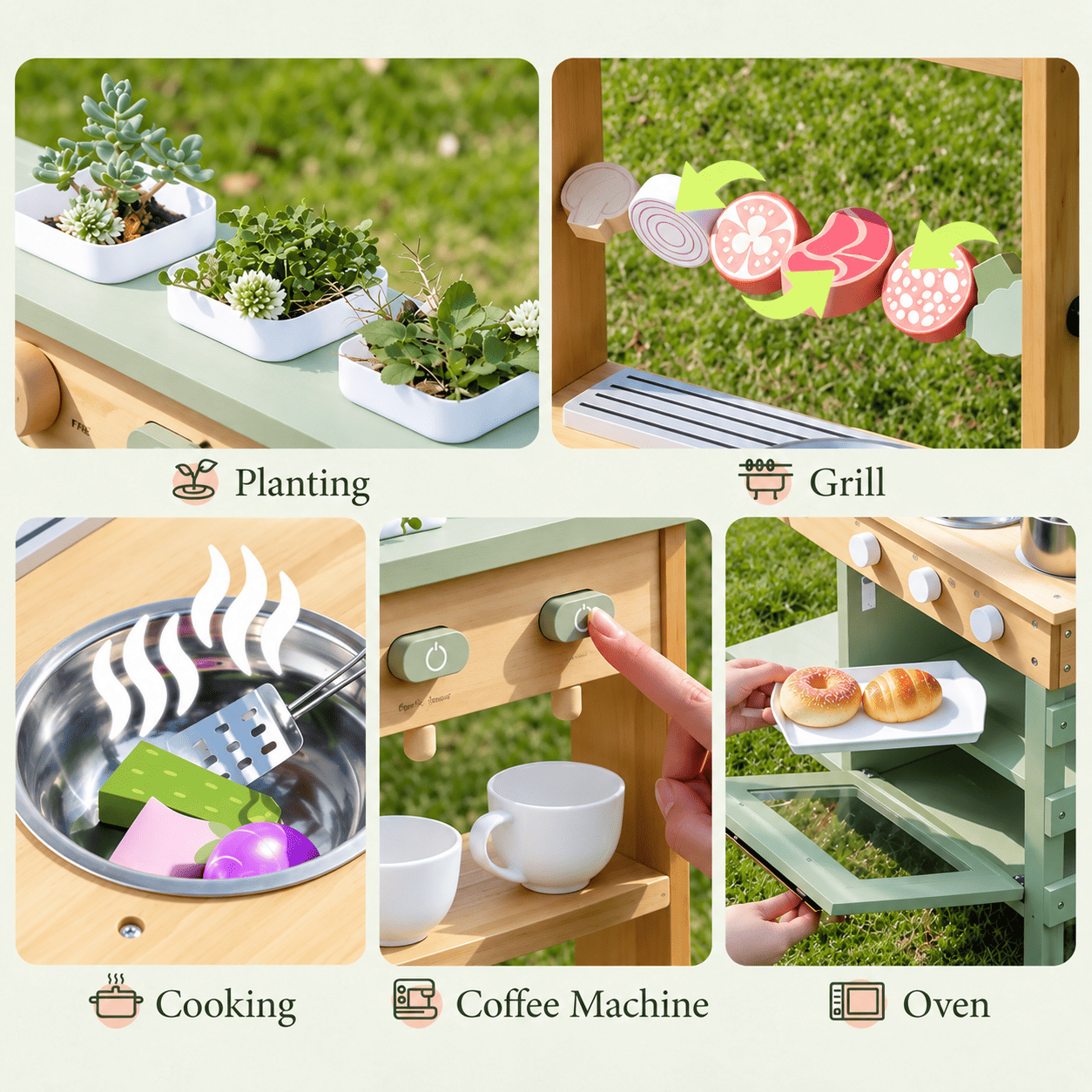
- ROBUD Outdoor Mud Play Kitchen (Green): This one packs in a removable sink, working faucet, hob area, and a coffee or juice maker, giving you three or four separate "stations" so a small group can cook, pour, and mix at the same time without queuing. Rated for ages 3 and up, CE-marked and EN71 tested, which matters if you're buying for a registered setting.
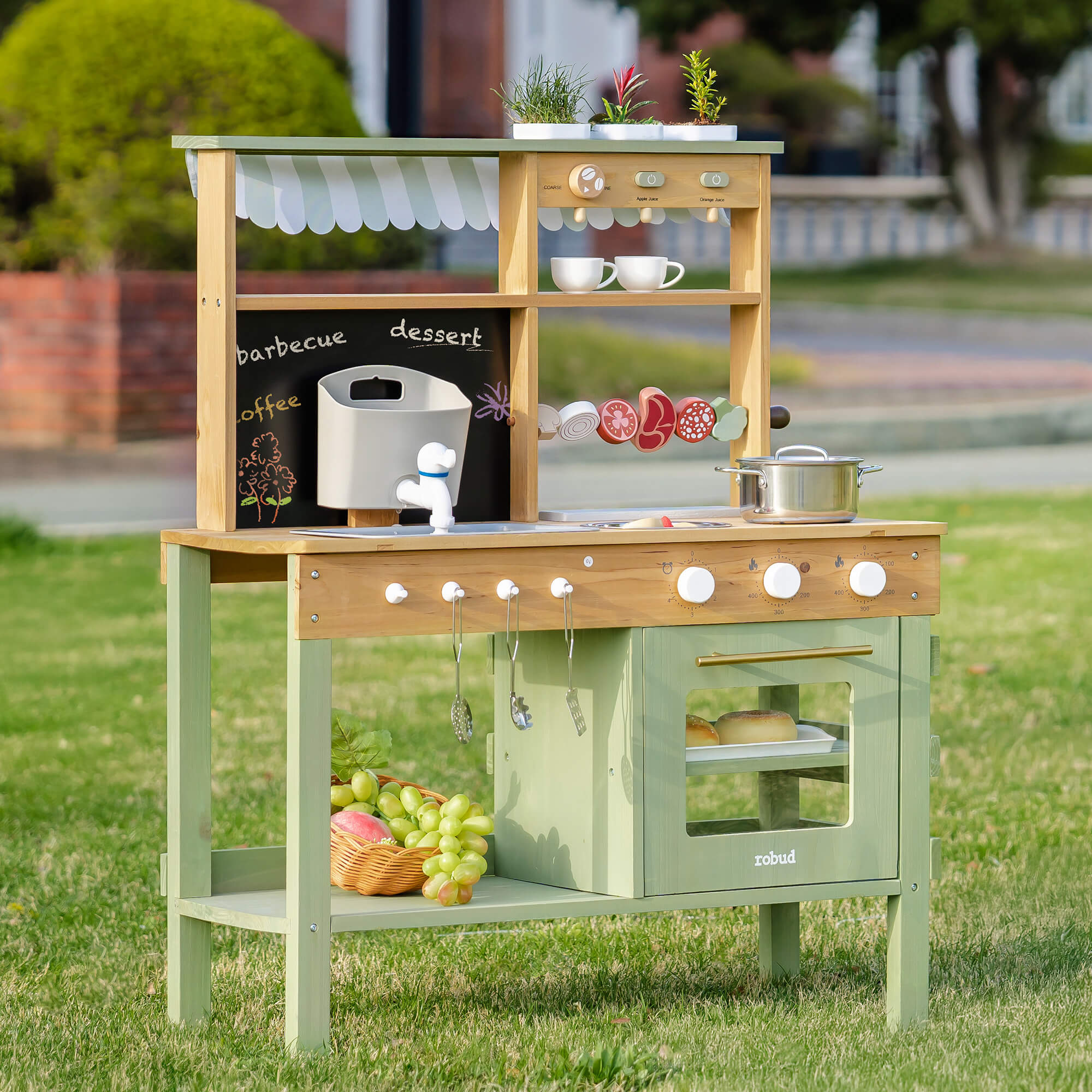
- ROBUD Mud Kitchen for Kids Outdoor with Canopy: The built-in canopy is the standout feature here, keeping children shaded so outdoor learning can carry on through a sunny afternoon instead of being cut short. It also has a sink, stove, chalkboard, and storage shelves, so mark-making and mud play sit side by side.

- ROBUD Outdoor Mud Kitchen (Caramel): A simpler, more compact build with a sink and storage area, this suits smaller settings, toddler rooms, or childminders working with one or two children at a time rather than a full nursery cohort.

- ROBUD Mud Kitchen for Kids Outdoor with Canopy & Wheels: Built-in wheels and a handle mean this one can be moved around the garden or wheeled into storage at the end of the day, which is genuinely useful for settings that rotate equipment between different outdoor zones or share a garden with another room.

Stock and pricing change, so it's worth checking the Robud outdoor mud kitchen collection directly before you order for a setting.
The Activity Ideas
Once the kitchen itself is sorted, here are fifteen ways to actually put it to work across the EYFS year:
- Mud pie bakery: Set out muffin trays, an old rolling pin, and cookie cutters so children can mix, shape, and "bake" mud pies, then decorate them with petals or leaves.
- Potion mixing station: Add small bottles, funnels, and a few drops of food colouring to water so children can invent potions, naming ingredients and describing colour changes as they go.
- Mark-making menu: Hang a small chalkboard in the kitchen and encourage children to "write" today's specials, copying letters or inventing their own marks for what's on offer.
- Sensory soup: Fill the sink with warm water, herbs, and vegetable peelings so children can stir up "soup," practising scooping and pouring while exploring different smells and textures.
- Leaf and petal salad: Send children on a short collecting walk first, then let them chop (with safety scissors), toss, and "serve" a salad from what they've gathered.
- Café role play: Set up a takeaway hatch with paper cups and an order pad, letting one child take orders while others cook, building early literacy and turn-taking together.
- Building-site mud mix: Add small buckets, trowels, and toy trucks so mud becomes cement, connecting the kitchen to construction and small-world play.
- Weighing and measuring station: Bring out a simple balance scale and measuring cups so children compare how much mud, sand, or water different containers hold.
- Colour mixing lab: Give children primary-coloured water in jugs and empty pots, then let them combine colours and talk about what new shades appear.
- Bug hotel bakery: Use twigs, leaves, and mud to build tiny homes for imaginary (or real) minibeasts, linking the kitchen to nature study and understanding the world.
- Seasonal recipe cards: Swap ingredients with the seasons, autumn leaves and conkers in October, snowballs and icy water in winter, so the kitchen stays fresh across the year.
- Water pouring practice: Line up jugs, funnels, and containers of different sizes purely for pouring practice, a simple activity that does a lot of quiet work for fine motor control.
- Story-inspired cooking: Read a story like The Enormous Turnip or We're Going on a Bear Hunt, then let children recreate a scene or "cook" something from the tale at the kitchen.
- Mud kitchen café for grown-ups: Invite parents or another class to "order" from the children's menu at pickup time, giving the play a real audience and a reason to communicate clearly.
- Clean-up crew: Turn tidying the kitchen into its own activity, with washing-up bowls, brushes, and clothes, so children practise responsibility and see that mess has a natural end point.
What Do You Need for an EYFS Mud Kitchen?
You don't need much to get started, and most of it costs nothing at all.
- A sturdy outdoor kitchen unit: A wooden mud kitchen with a sink, worktop, and storage gives children a defined space to work in and holds up far better outdoors than repurposed furniture.
- Water access: A tap nearby, a watering can, or a couple of large water butts keep the kitchen topped up without staff running back and forth all day.
- Mud, sand, and natural loose parts: Pine cones, twigs, leaves, petals, conkers, and shells all add variety and change with the seasons for free.
- Kitchen tools: Old pots, pans, wooden spoons, measuring jugs, funnels, and muffin trays from a charity shop work just as well as anything bought new.
- Aprons or old clothes: Waterproof aprons or a box of donated old t-shirts save on laundry and give children permission to get properly stuck in.
- A chalkboard or mark-making area: A small board or laminated menu card invites writing and drawing without anyone having to ask for it.
- Storage: A lidded box or nearby shed keeps tools dry and stops them scattering across the garden overnight.
How to Set Up a Mud Kitchen for Nursery or Preschool
Getting a mud kitchen right for a group setting is a bit different from setting one up in a back garden, mostly because of numbers, safety, and daily wear.
Start with position: Place the kitchen somewhere with reasonably easy access to water, ideally under a tree, canopy, or gazebo so play can continue on hot or drizzly days. A hard, well-draining surface underneath, like bark chip or rubber matting, stops the whole area turning into a bog after heavy rain.
Think about numbers next: A single kitchen unit realistically supports three to four children comfortably. If your cohort is bigger, either choose a kitchen with several stations, like a sink plus a separate hob area, or add a second unit rather than squeezing everyone around one sink.
Safety: Look for CE-marked, EN71-tested equipment, check for splinters or loose fittings weekly, and make sure any standing water is drained or covered when the kitchen isn't supervised.
Rotate the resources regularly: Swapping loose parts with the seasons, adding new tools every few weeks, or introducing a themed challenge keeps the kitchen from going stale, since children notice fast when the same three pots have been sitting there since September.
Making Mud Kitchen Play Part of Outdoor Learning
A mud kitchen works best when it isn't treated as an isolated activity but woven into the wider outdoor learning environment. Position it near a digging patch, a small world area, or a reading nook, and children will naturally carry ingredients, stories, and ideas between them.
Link it to what's already happening in the setting too. If the class is exploring a book about the seasons, bring autumn leaves to the kitchen that week. If maths focus is on capacity, add a "which jug holds more?" challenge to the worktop. None of this needs a formal lesson plan bolted on. A well-stocked mud kitchen, checked and refreshed regularly, does most of the teaching by simply being available.
Over a full year, this is what turns a mud kitchen from a nice-to-have into genuine outdoor learning: consistency. Children who know it's there every day, rain or shine, use it with a confidence and creativity that's hard to replicate indoors.
FAQs
What age group is a mud kitchen suitable for?
Most mud kitchens, including Robud's range, are rated from age 3 and up, which covers the bulk of EYFS nursery and reception children. Younger toddlers can still enjoy supervised water and sand play alongside an older sibling or key worker.
Do I need real mud, or can I use something else?
Real mud works well and costs nothing, but you can also use a compost and water mix, sand and water, or even oats and water for a lower-mess, indoor-friendly alternative during wet weather.
How do I keep a mud kitchen clean and hygienic?
Rinse tools after each session, let the kitchen dry out between uses, refresh mud and sand regularly, and give the whole unit a proper wash down every few weeks to stop mold building up on wood.
Can a mud kitchen be used indoors?
Most mud kitchens are built for outdoor conditions, but a scaled-down water and sand tray can bring similar sensory play indoors on days when the garden isn't an option.
How much outdoor space does a mud kitchen need?
There's no strict minimum, but allowing roughly a metre of clear space around the kitchen gives children room to move, carry containers, and play without bumping into each other constantly.
Is a mud kitchen a requirement under the EYFS framework?
No specific piece of equipment is mandatory under EYFS, but the framework does require settings to provide rich outdoor learning opportunities, and mud kitchens are one of the most widely used ways settings choose to meet that.
Comment