 United Kindom
 United States
 Europe
 Australia
 France
 Spain
Spain
 Italy
Italy
 Canada
Play Kitchen vs Building Blocks: Which Toy Is More Beneficial?
Jun 02,2026 | Josephine Delima
A child wearing a chef’s hat and “serving” imaginary soup to stuffed animals may look completely different from another child stacking wooden towers taller than the couch cushions. Yet both are doing serious developmental work disguised as play.
Parents often wonder which toy gives children a bigger advantage: a play kitchen or building blocks. The truth is, this isn’t really about choosing a “better” toy. It’s about understanding how each toy shapes your child’s brain, creativity, confidence, and everyday life skills.
Before you invest in a toy that will likely take over your living room floor, it helps to know what your child is truly learning while they play. This guide will answer your curiosity.
What the Research Actually Says About Play-Based Learning
Research consistently shows that play is not separate from learning—it is learning. Open-ended toys, especially those that allow children to imagine, build, experiment, and role-play, support multiple areas of development at once.
According to research by the Chartered College of Teaching, play-based learning has been associated with positive development of the brain. They also promote language development, social-emotional skills, creativity, and fine motor coordination.
What makes toys like play kitchens and building blocks especially powerful is that they are child-led. There’s no single “correct” way to use them. That freedom encourages independent thinking and deeper engagement.
Instead of passively watching a screen, children become active participants in their own learning experiences.
Play Kitchens: What They're Really Teaching Your Child
At first glance, a play kitchen might seem like just another cute toy filled with tiny pots and pretend vegetables. But underneath the pretend pancakes and imaginary tea parties is an incredible amount of developmental value.
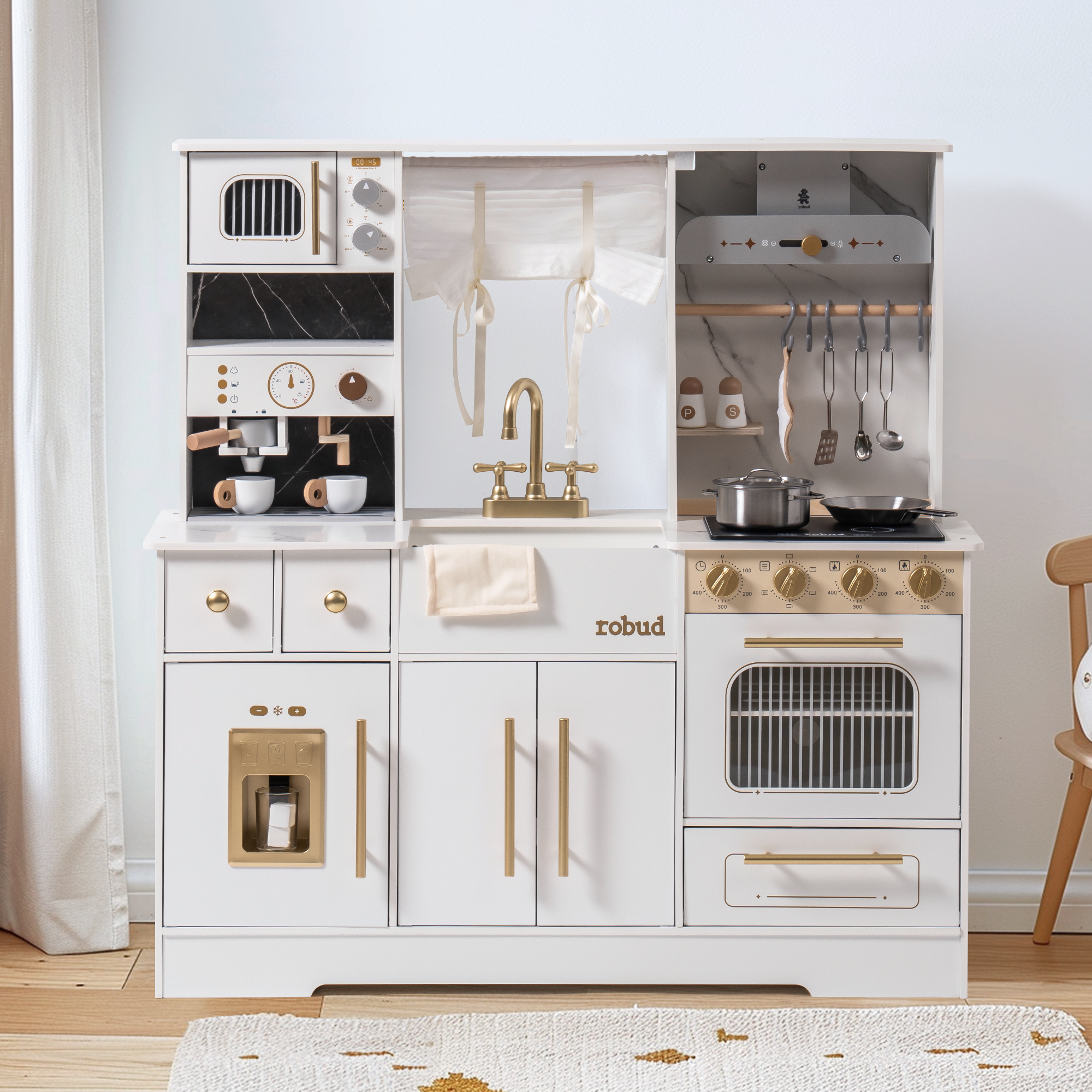
ROBUD Modern Play Kitchen for Kids - White
Communication and Language Skills
Play kitchens naturally encourage conversation. Children narrate what they’re doing:
- “I’m making soup.”
- “Do you want pizza?”
- “The oven is hot!”
This type of pretend dialogue expands vocabulary, sentence structure, and conversational confidence. Kids also begin learning sequencing and storytelling through role-play.
Emotional Intelligence and Social Skills
Pretend cooking often mirrors real-life caregiving. Children imitate parents, grandparents, siblings, or favorite characters. They practice sharing, taking turns, hosting others, and cooperation.
When kids “serve” food to others, they are rehearsing social interactions in a safe and playful environment.
Independence and Confidence
A play kitchen gives children control over their own little world. They make decisions independently:
- What to cook
- How to organize utensils
- Who gets served first
- What ingredients to combine
This boosts confidence and nurtures decision-making skills.
Real-World Familiarity
Pretend kitchens help children understand everyday routines and responsibilities. Simple activities like “washing dishes” or “making breakfast” help kids become more comfortable with daily life skills and household concepts.
Creativity and Imagination
One day the kitchen becomes a bakery. The next day it transforms into a restaurant, café, or magical potion shop. The possibilities are endless because pretend play relies heavily on imagination.
Building Blocks: The Surprisingly Deep Benefits
Building blocks may look simple, but they challenge children in surprisingly sophisticated ways.
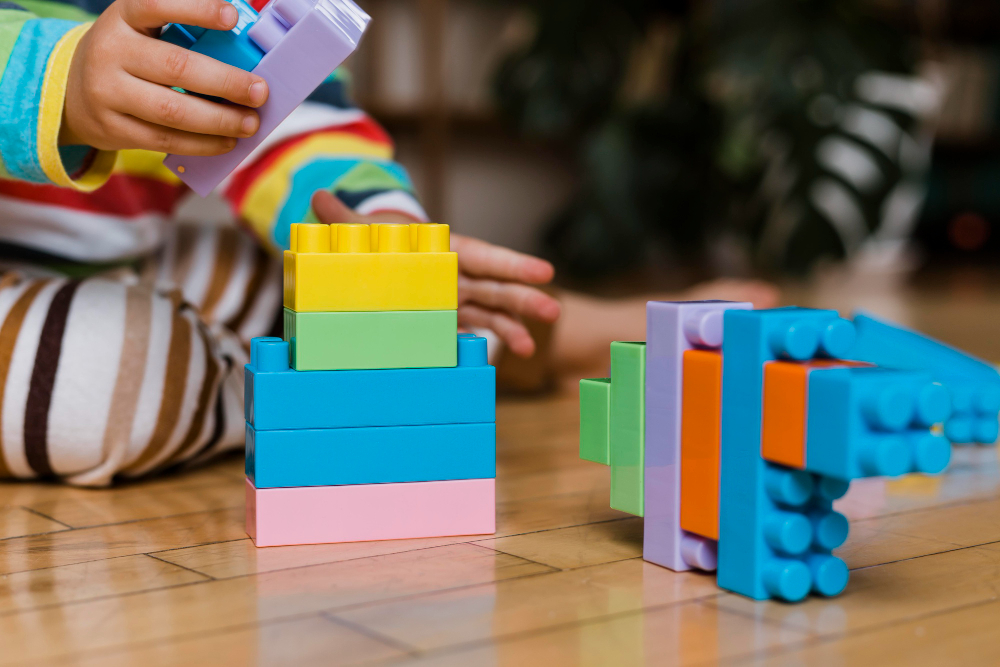
Every tower, bridge, and castle introduces lessons in balance, structure, physics, and persistence.
Spatial Awareness and STEM Foundations
Block play is strongly connected to early engineering and math skills. Children learn concepts like balance, geometry, and symmetry. They begin understanding how objects fit together and how structures behave in space.
Problem-Solving Skills
Blocks constantly create mini challenges:
- “Why did the tower fall?”
- “How can I make this stronger?”
- “What piece fits here?”
This trial-and-error process strengthens logical thinking and resilience.
Fine Motor Development
Picking up, rotating, balancing, and stacking blocks helps strengthen hand muscles and coordination. These fine motor skills later support writing, drawing, and cutting with scissors.
Patience and Persistence
Unlike toys with instant results, building takes time. Children learn that mistakes are part of the process. Towers collapse. Bridges wobble. Designs fail. And then they try again. That persistence is one of the most valuable life skills children can develop.
Head-to-Head: 7 Developmental Categories Compared
- Creativity
Both the play kitchen and building blocks encourage imagination, but in different ways. Play kitchens focus on storytelling and role-play. Building blocks focus on design and invention. - Social Development
Pretend kitchens naturally encourage conversation, cooperation, and shared role-play. Children often play “together” more easily with kitchen sets. - STEM and Problem-Solving
Blocks offer stronger foundations for engineering concepts, spatial reasoning, and structural experimentation. - Language Development
Role-playing meals, restaurants, and family interactions create constant opportunities for verbal expression. - Fine Motor Skills
Precise stacking and balancing demand stronger hand coordination and control. - Emotional Expression
Pretend caregiving helps children process emotions and practice empathy. - Longevity of Use
Blocks often evolve with children for many years, from simple stacking in toddlerhood to complex creations later on.
Which Toy Is Right for Which Age?
Ages 1–2
Toddlers benefit greatly from stacking, knocking down, and experimenting with cause and effect. Soft or oversized wooden blocks work especially well at this stage.
Ages 2–4
This is the golden age of pretend play. Children begin copying adult behavior and creating imaginative scenarios while still enjoying basic construction activities.
Ages 4–7
At this stage, children create more complex stories and structures. They may build restaurants, grocery stores, or entire cities using blocks alongside pretend kitchen play.
Ages 7+
Older children often gravitate toward more challenging construction toys that allow detailed building and engineering exploration.
FAQs
Is a play kitchen good for boys too, or just girls?
Absolutely. Play kitchens are beneficial for all children regardless of gender. Cooking, caregiving, communication, and creativity are universal life skills. Boys gain the same developmental benefits from pretend kitchen play as girls do.
At what age should a child stop playing with building blocks?
There’s really no strict age limit. Many older children continue enjoying advanced block systems, architectural builds, and engineering-focused construction toys well into their pre-teen years.
Can a play kitchen and building blocks be used together?
Yes, and they work incredibly well together. Children often combine both toys to create restaurants, grocery stores, homes, cafés, and imaginative worlds that encourage richer storytelling and problem-solving.
How much should I spend on a play kitchen?
A quality wooden play kitchen can range anywhere from affordable compact models to larger premium sets. Focus less on flashy electronics and more on durability, safety, and open-ended accessories. Well-made wooden kitchens often last for years and can even be passed down to younger siblings.
Do kids actually learn from play kitchens, or is it just fun?
They absolutely learn through play kitchens. Pretend play supports language development, emotional intelligence, social interaction, creativity, and everyday life understanding, all while keeping children engaged and entertained.
Comment